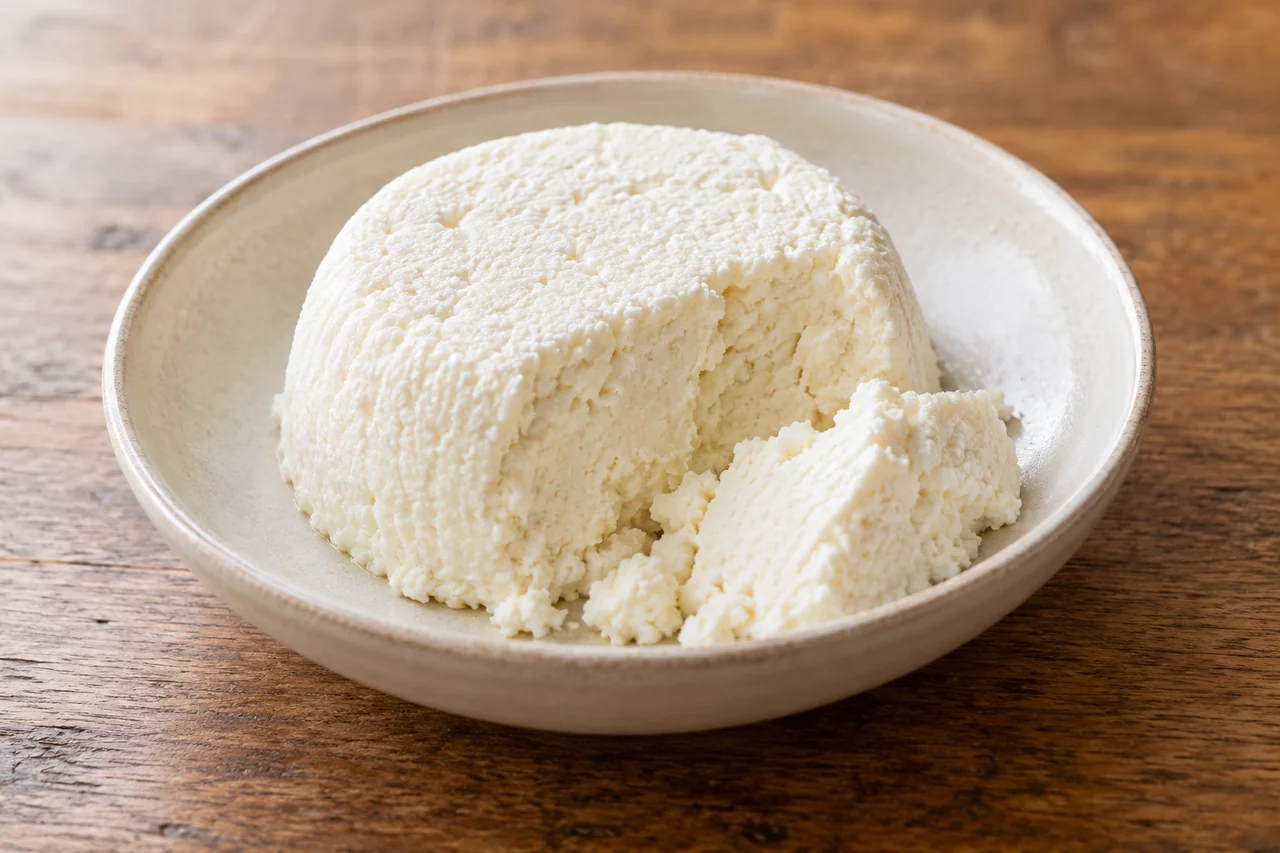
Soft fresh milk curds, gently drained into a small cheese using culinary lemon juice.
Wara connects cattle-rearing and dairy work with the food markets of southwestern Nigeria. Researchers Orhevba and Taiwo describe Fulani women turning surplus milk into this unripened cheese and document lemon juice as one possible coagulant. Fresh wara is delicate and can be eaten with savoury accompaniments or cooked further in a stew. This home version uses pasteurized milk and lemon rather than plant latex. The method changes the flavour slightly, so it is presented openly as a lemon-set adaptation of dairy wara.
Cultural context: FUT Minna researchers describe Fulani milk production and wara markets in southwestern Nigeria. This is dairy wara; soybean awara/beske remains a separate recipe.
Wash hands and clean the pot, sieve and food-grade muslin thoroughly. Set the lined sieve over a deep heatproof bowl.
2
Warm milk slowly in a heavy pot, stirring at the base, until 90–95°C. Do not let it boil over or scorch.
3
Reduce heat and gently stir in 60 ml lemon juice. Wait 3 minutes. If separation is incomplete, add the remaining juice 10 ml at a time until soft curds form in clearer yellowish whey.
4
Keep just below simmering for 3–5 minutes without vigorous stirring. Turn off the heat and rest 10 minutes to let the curds gather.
5
Ladle into the lined sieve. Add optional salt and drain for 20–30 minutes. Fold the cloth over and apply only light pressure for a soft cake; heavy pressing gives a denser result.
6
Transfer to a clean covered container and refrigerate immediately once draining is complete. Use within 2 days; do not keep fresh cheese at room temperature. Serve chilled or heat it thoroughly in a sauce.
A little kitchen wisdom
Do not use Calotropis, papaya latex, alum or unidentified leaves in this home adaptation.
Yield depends on milk composition and drainage; four servings is an estimate.
Timing estimate: active preparation 10 min; cooking 30 min; additional passive time 45 min; conservative planning allowance 85 min. Some stages may overlap.
Recipe status: Research formulation; not kitchen-tested.
Allergen checks: Milk
Recipe notes & sources
Research formulation; not kitchen-tested
Also known as: Warankasi, Wara-kasi
FUT Minna researchers describe Fulani milk production and wara markets in southwestern Nigeria. This is dairy wara; soybean awara/beske remains a separate recipe.

 Ose’s Delta Table





Around the table 0
Be the first to start the conversation.